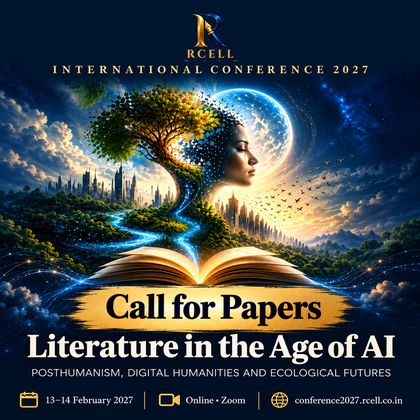
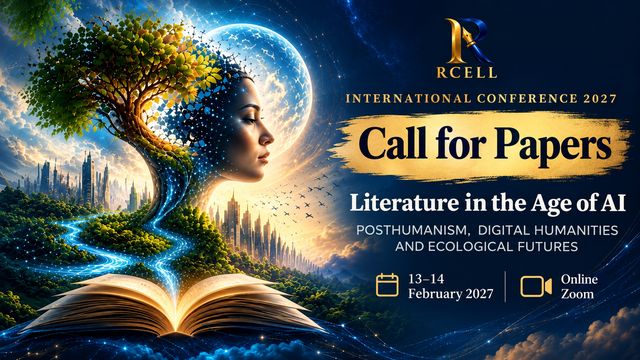
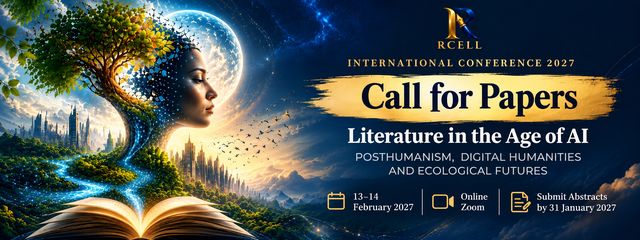
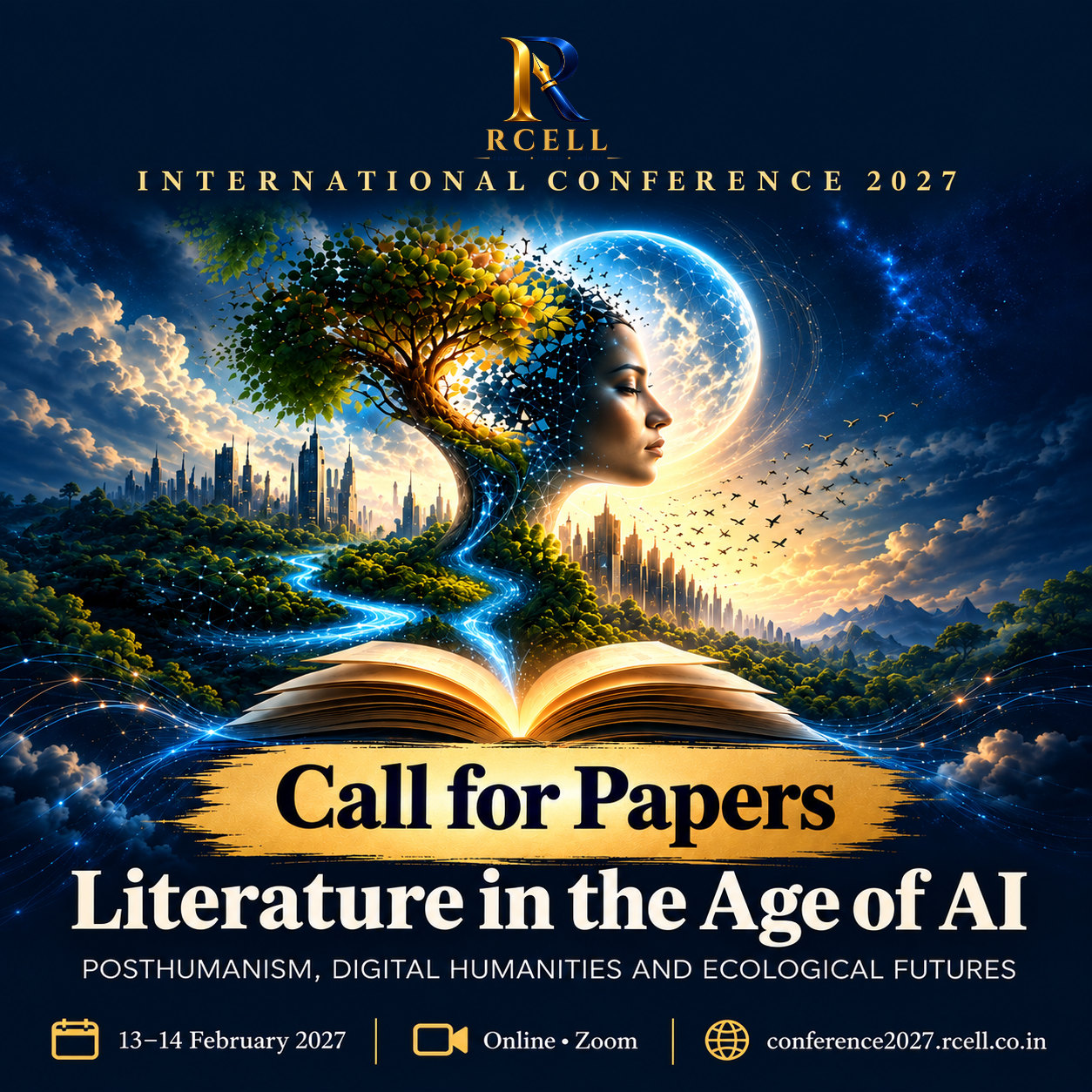
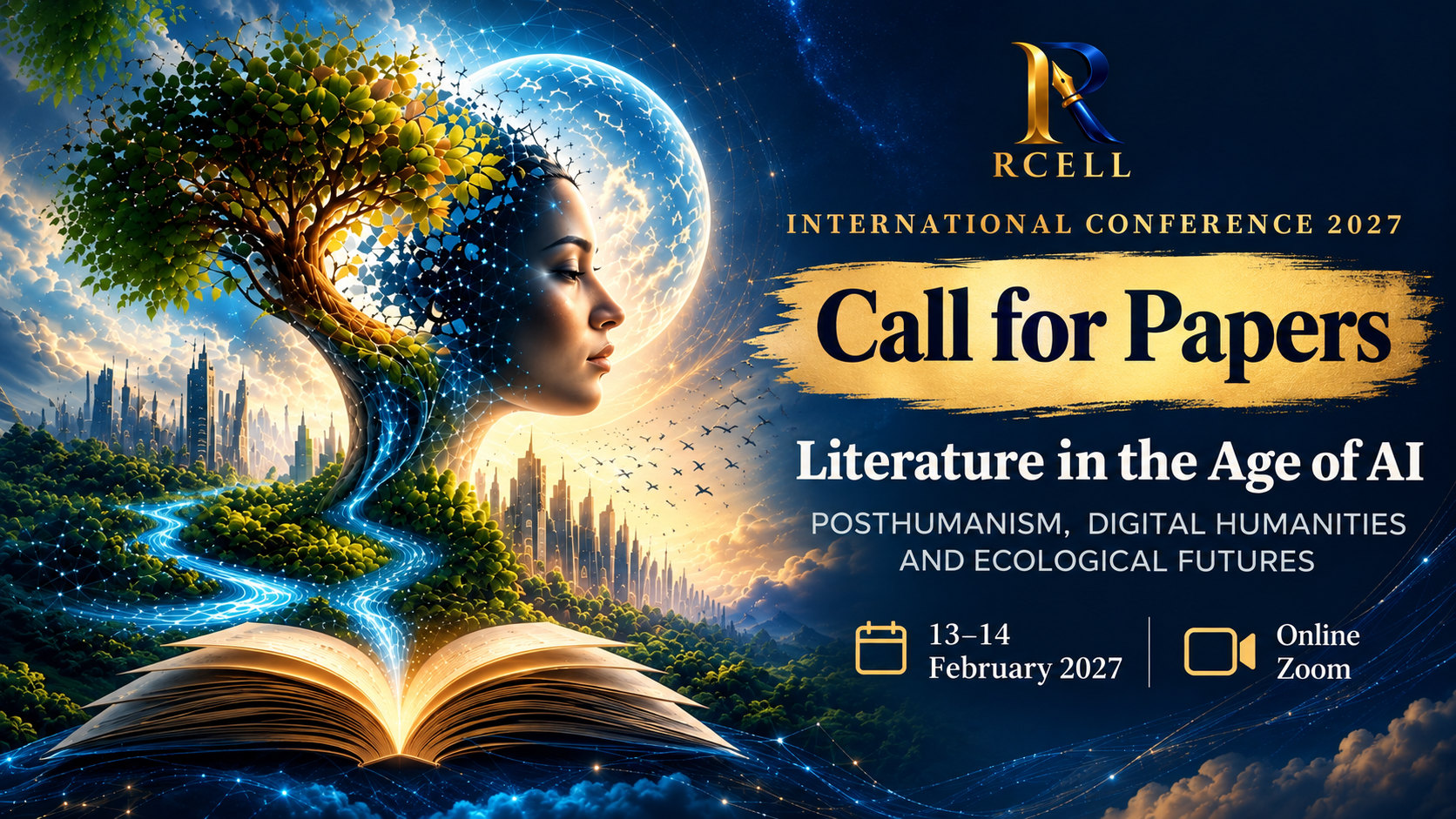
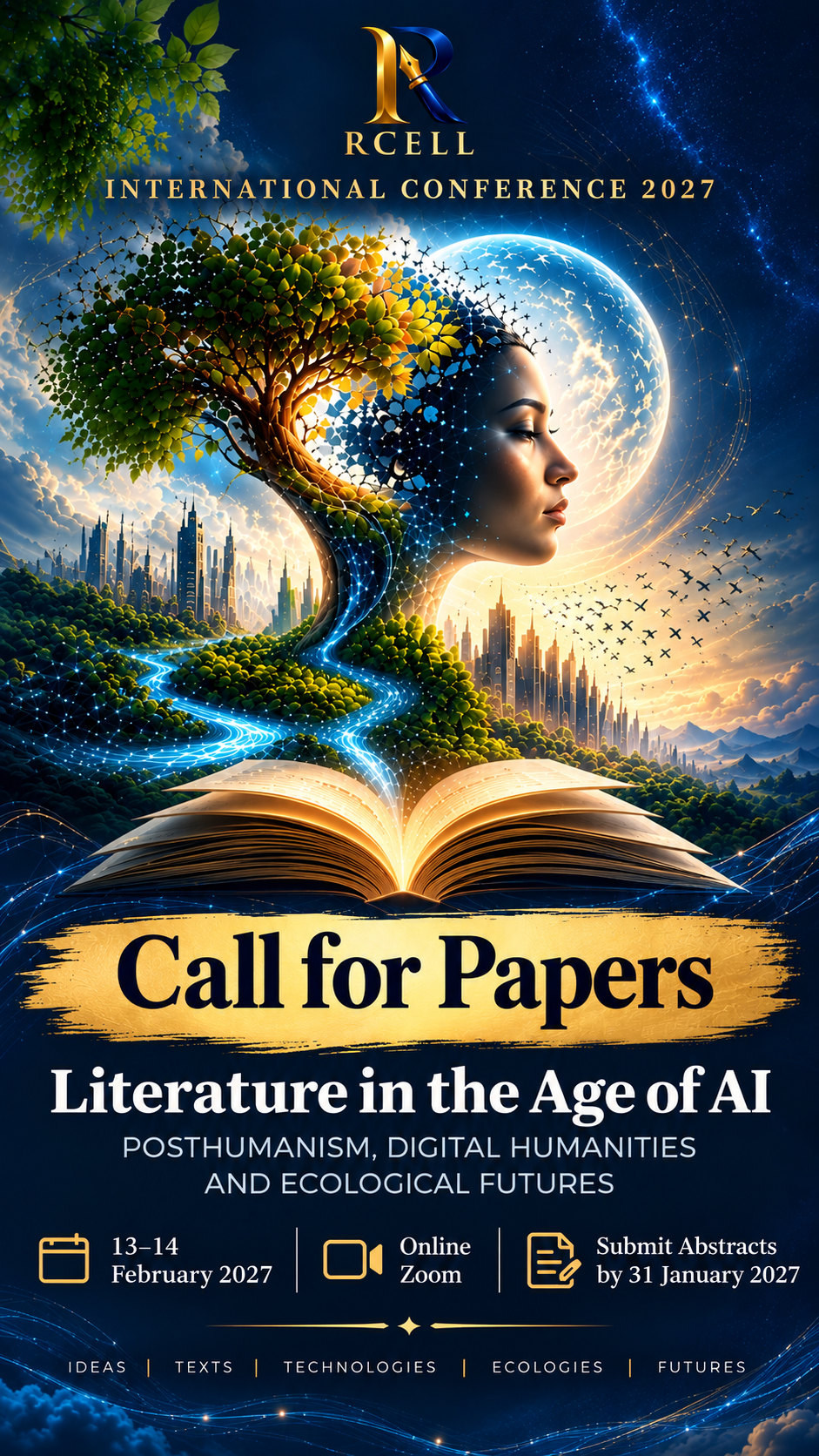
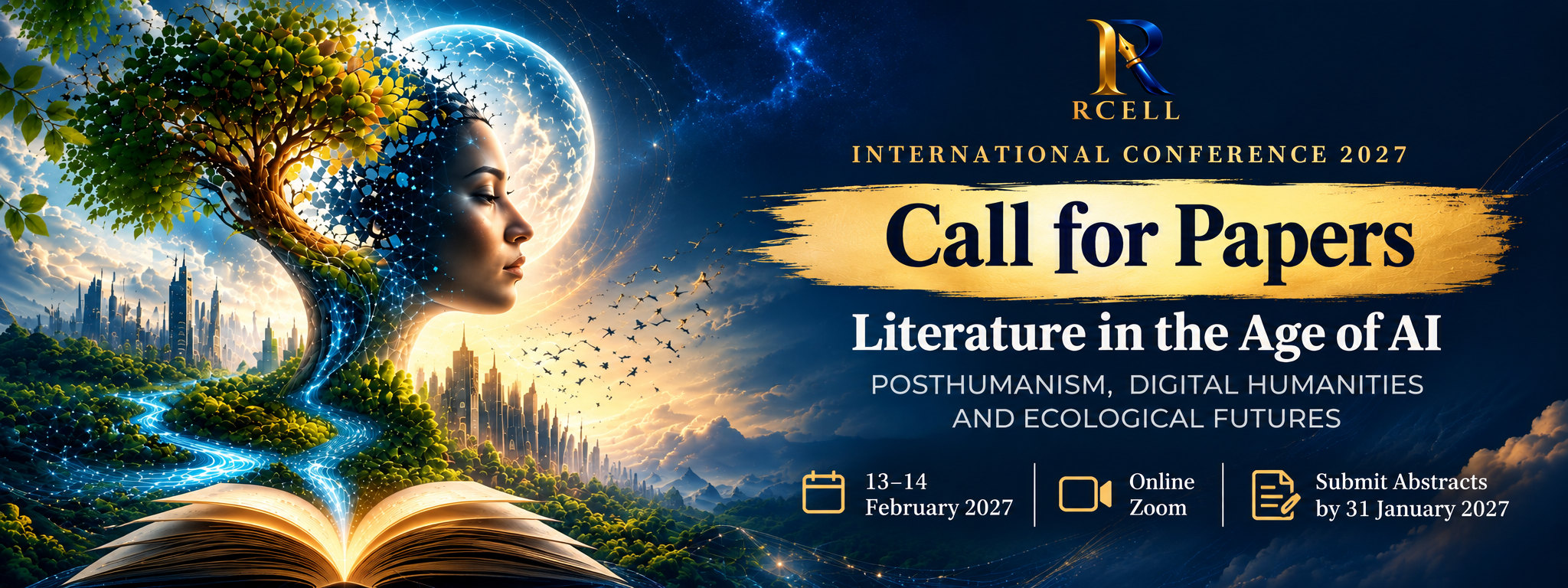
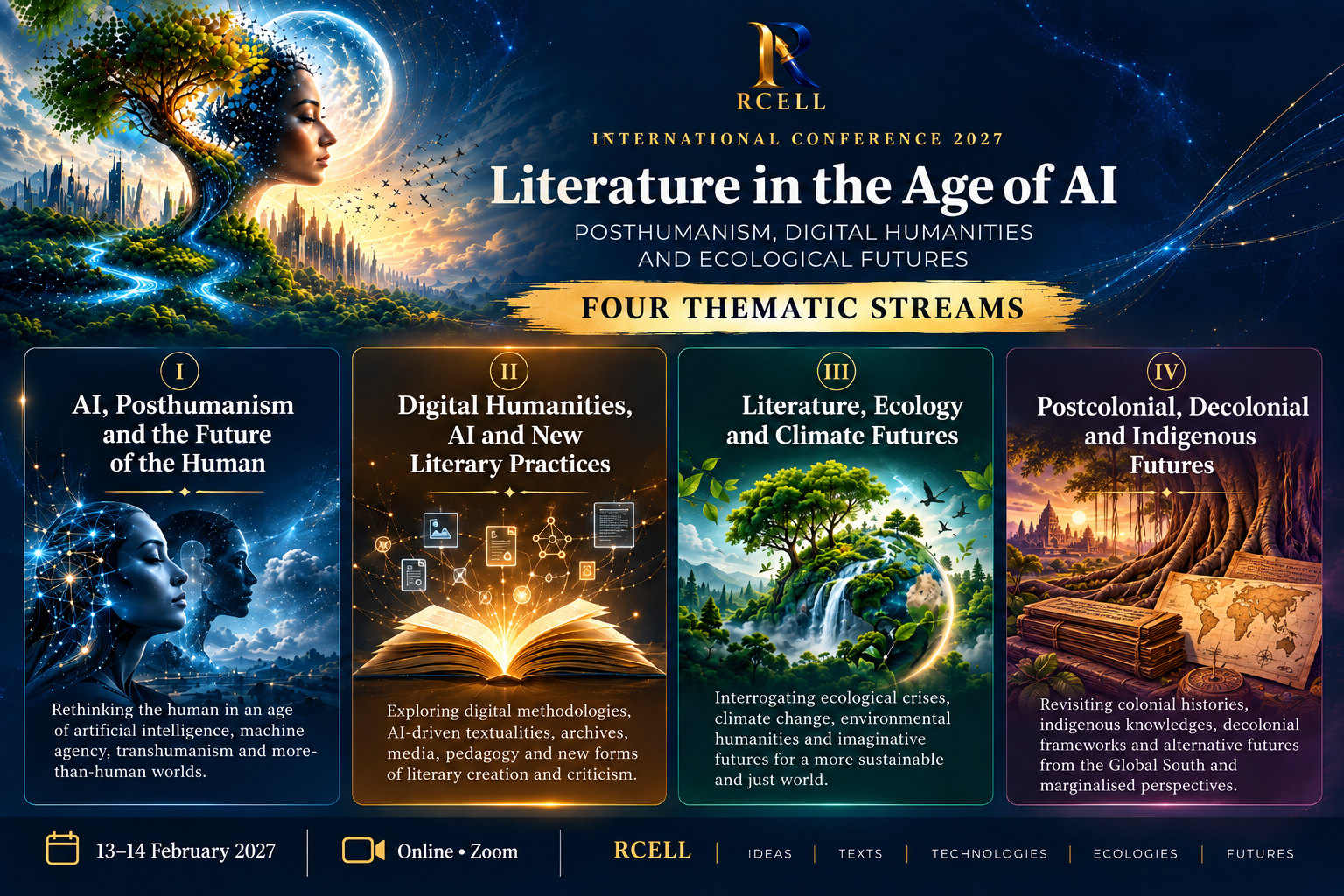
RCELL International Conference 2027: Posthumanism, Digital Humanities and Ecological Futures: Literature in the Age of AI. 13–14 February 2027, Online, Zoom.

Abstract Submission Now Open • Deadline: 20 December 2026 (proposed)

8 Keynote Speakers
4 Thematic Streams
2 Conference Days
30+15 Keynote Format (min)
~10 Min Per Paper
Special Issue The Criterion Journal
About the Conference

An International Conversation at the Intersection of Literature, Technology and the Future

We live at a moment when the categories that have long organised literary and cultural study (the human, the natural, the written, the creative) are being fundamentally rethought. Artificial intelligence, ecological crisis, and digital culture are not peripheral concerns; they are reshaping what literature means, who makes it, and how it is read.

RCELL International Conference 2027 brings together scholars, researchers, and teachers of literature to examine these transformations across three connected intellectual frameworks: posthumanism, digital humanities, and ecological thought. This is a humanities and English Studies event, focused on culture, meaning, and the literary imagination, not on technical computing.

The conference explicitly welcomes South Asian perspectives, including Indian-language literatures, Dalit and Adivasi ecological narratives, regional literary archives, and postcolonial engagements with climate, technology, and modernity. This is a distinctive intellectual location, not a restriction.

What does AI mean for literature?

Questions of intelligence, creativity, authorship, and interpretation are being asked anew in the age of generative AI, and literary studies has much to contribute to those conversations.

What is the posthuman?

Posthumanism challenges human exceptionalism and asks how literature has always staged the boundaries between the human and the non-human.

Whose ecological future?

Ecological thought demands that questions of justice, extraction, and survival be brought back to literary criticism and the humanistic imagination.

Conference at a Glance

📅
Dates 13–14 February 2027 (provisional)
🌐
Format 100% Online via Zoom Pro
🏫
Discipline English Studies and Humanities
📝
Abstract 250–300 words; submission via Google Form
🏆
Certificates E-certificates issued to all confirmed participants
📚
Publication Special issue considered in The Criterion: An International Journal in English (ISSN 0976-8165)
🏠
Organiser RCELL, Research Centre for English Language and Literature
👤
Chief Convener Dr. Madhuri Bite
Director, RCELL; Managing Editor, The Criterion
👥
Honorary Academic Adviser Dr. Vishwanath Bite
Participation

Who Should Participate?

This conference welcomes participants from across the humanities and English Studies. Whether you are presenting a paper, attending as a delegate, or joining to hear the keynote lectures, you are part of the conversation.

🏫

Research Scholars and Doctoral Candidates

Researchers at all stages working in English literature, cultural studies, comparative literature, digital humanities, or ecocriticism, including those preparing or completing doctoral dissertations.

📚

Academic Faculty

Faculty members from universities and colleges who wish to present research, engage with emerging scholarship, or explore the conference themes in relation to their teaching and writing.

👥

Postdoctoral Fellows

Early-career researchers developing work in posthumanism, digital humanities, ecocriticism, postcolonial studies, or adjacent fields who seek a peer-reviewed international forum.

🌎

Independent Scholars

Researchers working outside formal institutional structures who are engaged with the conference themes and whose work meets the scholarly standards of peer-reviewed academic presentation.

📄

Listeners and Delegates

Participants who wish to attend the conference without presenting a paper are welcome to register as listeners or delegates. Listener registration is a separate, simpler process and is open to all.

🌏

International Participants

The conference is fully online and welcomes participants from all geographies. South Asian perspectives, including Indian-language literatures and postcolonial frameworks, are particularly encouraged.

Why Participate

What the Conference Offers

01

Peer-Reviewed International Forum

Abstracts are reviewed for thematic fit, scholarly clarity, and originality. The conference provides a rigorous, indexed academic record of your participation through an e-certificate issued to all confirmed attendees.

02

Publication Pathway in The Criterion

Selected full papers presented at the conference may be invited to a special issue of The Criterion: An International Journal in English (ISSN 0976-8165), subject to independent peer review and editorial acceptance. Papers accepted for the special issue will receive DOI registration.

03

Eight Distinguished Keynote Lectures

The conference will feature eight keynote lectures (two per thematic stream), each comprising a 30-minute address followed by a 15-minute question and discussion period. Keynote speakers will be announced after written confirmation is received.

04

Accessible Online Format

Delivered entirely via Zoom Pro, the conference removes barriers of travel and cost while maintaining the quality of live scholarly exchange. All registered participants receive full access to all sessions across both days.

05

South Asian and Global Perspectives

The conference is organised by RCELL and is explicitly designed to hold South Asian scholarly voices alongside international scholarship, creating an intellectually productive encounter between different critical traditions.

06

Timely and Consequential Themes

Posthumanism, digital humanities, and ecological futures are among the most pressing areas of contemporary humanistic inquiry. This conference places literary scholarship at the centre of those conversations rather than at their margin.

Conference Theme

Three Frameworks for Rethinking the Human

The conference title names three intellectual fields that are reshaping how we read, write, teach, and think. They are not separate tracks; they converge in questions about what it means to be human in a world altered by technology, ecological precarity, and new ways of knowing.

I

Posthumanism

A critical reconsideration of the human as the natural centre of culture, ethics, and meaning. Posthumanism asks how literature has always staged the boundaries between the human, the animal, the technological, and the more-than-human. In the age of AI, these questions are no longer abstract: they structure daily life and daily reading.

II

Digital Humanities

The intersection of computational methods, digital archives, and literary scholarship. Digital humanities asks how we read at scale, how we preserve and interpret textual heritage, and how AI is reshaping the tools and practices of literary criticism, pedagogy, and creative work.

III

Ecological Futures

Ecocriticism, climate fiction, and environmental humanities ask what literature has to say about the Anthropocene: about extinction, extraction, planetary limits, and the unequal distribution of ecological harm. Literary culture is not a bystander to climate crisis; it is one of the places where we imagine alternatives.

"This conference is a humanities and English Studies event. It is not a technical computing conference. Its central questions concern what literature means (who makes it, how it is read, whose voices it carries, and what imaginative work it can still do) in a world undergoing transformation at a scale we are only beginning to understand."

Thematic Streams

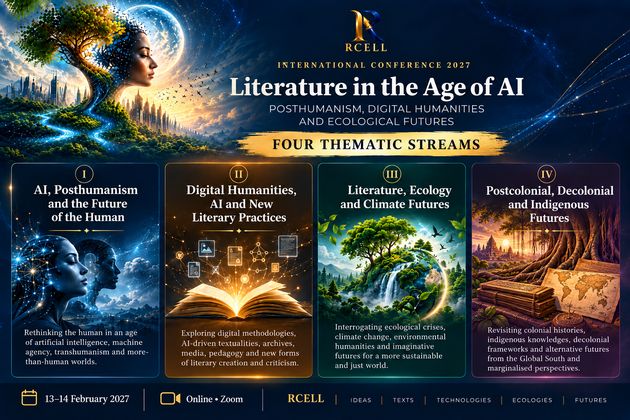
Four Streams of Inquiry

Papers are invited across four thematic streams. Select the stream that best fits your work when submitting your abstract. The sub-themes listed under each stream are indicative rather than exhaustive: work that engages the stream's central concerns is welcome even if it does not map exactly to a listed sub-theme.

This stream examines what AI, digital technology, and posthumanist theory mean for conceptions of the human, exploring how literature has imagined, critiqued, and theorised the boundaries between the human and the non-human, the organic and the technological. The sub-themes listed below are indicative rather than exhaustive.

AI characters, machine subjectivity, artificial life, cyborgs and androids in literature and film
Posthuman and transhuman imaginaries in fiction and cultural theory
Human and non-human boundaries, embodiment, affect, and consciousness
AI ethics, surveillance, algorithmic governance, and data cultures in literary representation
Automation, labour, precarity, platform capitalism, and inequality in fiction and cultural criticism
Speculative fiction and future-of-the-human narratives: science fiction, dystopia, and utopia
Biopolitics, necropolitics, and posthumanist governance in contemporary literature
Animal studies, zoocriticism, and the literary representation of non-human agency
Cyborg feminism, Harawayan technoscience, and feminist posthumanism
Transhumanism, life extension, enhancement, and the ethics of technological self-modification
Robot narratives, android ethics, and artificial consciousness in fiction and drama
Philosophy of mind, consciousness studies, and literary representation of artificial intelligence
Disability studies, crip theory, and posthumanism in literary and cultural contexts
Ontologies of the digital: virtuality, simulation, and the representation of digital life in fiction
Queer posthumanism and the destabilisation of human sexual and gender categories

This stream explores how digital methods and AI are reshaping literary scholarship, pedagogy, and creative practice, from computational reading to questions of authorship, creativity, and the ethics of AI-assisted research. The sub-themes listed below are indicative rather than exhaustive.

Computational literary studies, distant reading, and machine-assisted interpretation
Digital archives, textual scholarship, preservation, and access
AI-assisted literary criticism, research ethics, and the boundaries of scholarly authorship
Generative AI, authorship, creativity, and digital textuality
Algorithmic culture, platform aesthetics, and literary form in the digital age
Interactive fiction, transmedia storytelling, games, and digital narratives
Digital pedagogy, AI in the literature classroom, and the future of English Studies
AI translation, multilingual cultures, and the digital future of non-English literatures
Social media, digital publishing, and the changing forms of literary circulation
Hypertext, electronic literature, and the new poetics of the digital
Corpus linguistics, stylometry, and machine learning in literary analysis
Open access, scholarly communication, and the political economy of academic publishing in the digital age
Digital humanities methodology: debates, limitations, and the promise of the digital
AI and the arts: machine creativity, collaboration, and the challenge to aesthetic theory
Digital memory, loss, and the humanities of the archive in the age of platform capitalism

This stream addresses ecocriticism, climate fiction, and environmental humanities, exploring how literature imagines ecological crisis, non-human agency, and the futures that remain possible within the Anthropocene. The sub-themes listed below are indicative rather than exhaustive.

Ecocriticism, climate fiction (cli-fi), environmental dystopias and utopias
The Anthropocene, Capitalocene, and Plantationocene as literary and critical frameworks
Ecofeminism, animal studies, plant studies, and more-than-human agency in literature
Blue humanities: rivers, oceans, coasts, and waterscapes in literary imagination
Urban ecologies, environmental ethics, sustainability, and the Sustainable Development Goals in literature
Environmental justice, climate literacy, and the politics of ecological representation
The pastoral, nature writing, and the literary tradition of landscape in the age of climate crisis
Solarpunk, cli-fi, and green utopias: literature as ecological imagination
Extinction, biodiversity loss, and elegies for the more-than-human world
Food studies, agriculture, soil, and the literary politics of eating and land
Multispecies justice, interspecies ethics, and the literary re-imagining of ecological community
Deep ecology, dark ecology, and the limits of humanist environmentalism in literary criticism
The energy humanities: fossil fuels, petrofiction, and the cultural politics of extraction
Toxic cultures, chemical landscapes, and the literature of contamination
Climate grief, solastalgia, and the affective dimensions of ecological loss in contemporary fiction

This stream foregrounds postcolonial, decolonial, and Indigenous frameworks, addressing how colonialism, technology, and ecological thought intersect, with particular attention to South Asian, Dalit, and Adivasi perspectives. The sub-themes listed below are indicative rather than exhaustive.

Colonialism, technology, modernity, and postcolonial technological imaginaries
Decolonising the Anthropocene: postcolonial ecocriticism and Southern environmental thought
Indigenous and Adivasi ecological knowledge, environmental justice, and land rights in literature
Climate colonialism, extractivism, resource conflict, and contested landscapes in fiction
Migration, displacement, and ecological precarity in postcolonial narrative
Dalit ecologies and Dalit environmental humanities: land, labour, and literary politics
South Asian environmental humanities: rivers, forests, monsoons, and the literary landscape
AI and Indian languages: digital preservation of regional and multilingual literatures
Postcolonial digital humanities: archives, access, and the politics of data in the Global South
Afrofuturism, Afropessimism, and decolonial imaginaries in literature and cultural theory
Subaltern studies, voice, and the epistemology of postcolonial environmental knowledge
Third-World feminisms, ecofeminism, and the gendered dimensions of colonial ecological violence
Resistance narratives, social movements, and the literature of environmental activism
Postcolonial science fiction, speculative Afrofuturism, and indigenous futurisms
Ecolinguistics, language loss, and the relationship between ecological and linguistic diversity
Call for Papers

Abstract Submission is Now Open

1

Read the CFP and select your thematic stream (I to IV)

2

Prepare your abstract (250 to 300 words), keywords, biography, and AI-use disclosure

3

Submit via the official Google Form below

4

Receive automated acknowledgement; await decision by 5 January 2027 (proposed)

We invite abstracts from researchers, scholars, doctoral candidates, postdoctoral fellows, and academic faculty working across English Studies, comparative literature, cultural studies, digital humanities, ecocriticism, and related fields. Interdisciplinary work is welcome.

Abstract Requirements

Word Count 250 to 300 words
Keywords 4 to 6 keywords
Author Information Full name, affiliation, email, country
Biography Up to 75 words
Stream Select one thematic stream (I to IV)
AI Disclosure Declare any generative AI use

Presentation Format

Each paper presentation is approximately 10 minutes, followed by a collective question and discussion period shared across the session panel. Presentations will be delivered live on Zoom Pro. Presenters are asked to submit their slides before the event for technical preparation. Sessions will be recorded only with the written consent of all speakers.

Submission Checklist

  • Abstract: 250 to 300 words (excluding title and keywords)
  • Title of proposed paper
  • 4 to 6 keywords
  • Full name and institutional affiliation
  • Country and email address
  • Selection of one thematic stream (I to IV)
  • Short biography: up to 75 words
  • Declaration of originality
  • AI-use disclosure (if applicable)

On AI Disclosure

You must disclose if you have used any generative AI tool (such as ChatGPT, Copilot, Gemini, or similar) in preparing your abstract, even for language editing or grammatical checking. This disclosure does not disqualify your submission, but transparency is required. Full AI disclosure expectations will apply to the conference presentation and to any future full-paper submission.

Review Process

Abstracts are assessed for thematic fit, scholarly clarity, originality, and feasibility for oral presentation. The review process is conducted by the RCELL academic team. Submission does not guarantee acceptance, and abstract acceptance does not guarantee publication.

South Asian Perspectives Welcome

The conference explicitly encourages submissions engaging with Indian-language literatures, Dalit and Adivasi ecological narratives, regional literary archives, postcolonial climate thought, AI and Indian languages, and South Asian digital humanities.

Keynote Speakers

Distinguished Keynote Lectures

The conference will feature eight keynote speakers across the four thematic streams, with two keynote addresses per stream. Each keynote comprises a 30-minute lecture followed by a 15-minute discussion. Speakers will be announced after written confirmation is received.

Stream I

Keynote Speaker 1

To Be Announced

Stream I

Keynote Speaker 2

To Be Announced

Stream II

Keynote Speaker 3

To Be Announced

Stream II

Keynote Speaker 4

To Be Announced

Stream III

Keynote Speaker 5

To Be Announced

Stream III

Keynote Speaker 6

To Be Announced

Stream IV

Keynote Speaker 7

To Be Announced

Stream IV

Keynote Speaker 8

To Be Announced

Follow the official WhatsApp group for the earliest keynote announcements.

Programme

Conference Schedule

The full programme will be published after abstract acceptance and presenter confirmation. The structure below indicates the planned architecture for both days.

Day One (Saturday)

13 February 2027 (provisional)

TBA

Inaugural Session

Welcome address, opening remarks, and virtual lamp-lighting ceremony

TBA

Keynote Lecture 1 (Stream I)

30-minute address + 15-minute Q&A. Speaker: To Be Announced

TBA

Keynote Lecture 2 (Stream I)

30-minute address + 15-minute Q&A. Speaker: To Be Announced

TBA

Keynote Lecture 3 (Stream II)

30-minute address + 15-minute Q&A. Speaker: To Be Announced

TBA

Keynote Lecture 4 (Stream II)

30-minute address + 15-minute Q&A. Speaker: To Be Announced

TBA

Paper Presentation Sessions

Stream I (AI, Posthumanism and the Future of the Human) and Stream II (Digital Humanities, AI and New Literary Practices). Approximately 10 minutes per paper.

TBA

End of Day One

Social networking channel open for participants

Day Two (Sunday)

14 February 2027 (provisional)

TBA

Keynote Lecture 5 (Stream III)

30-minute address + 15-minute Q&A. Speaker: To Be Announced

TBA

Keynote Lecture 6 (Stream III)

30-minute address + 15-minute Q&A. Speaker: To Be Announced

TBA

Keynote Lecture 7 (Stream IV)

30-minute address + 15-minute Q&A. Speaker: To Be Announced

TBA

Keynote Lecture 8 (Stream IV)

30-minute address + 15-minute Q&A. Speaker: To Be Announced

TBA

Paper Presentation Sessions

Stream III (Literature, Ecology and Climate Futures) and Stream IV (Postcolonial, Decolonial and Indigenous Futures). Approximately 10 minutes per paper.

TBA

Closing Roundtable

The future of literary studies: reflections and directions

TBA

Valedictory Session

Closing remarks, certificate announcement, and vote of thanks

Note: Session times, panel chairs, paper titles, and room allocations will be published after abstract review and presenter registration are complete. Confirmed presenters will receive session allocations, Zoom instructions, and slide-submission guidance in advance of the conference.
Registration

Registration and Fees

Abstract submission is currently open and free. Registration and payment open after abstract acceptance, and are separate from the submission process. Two participation pathways are available: Presenter and Listener/Delegate.

📝

Paper Presenter

Submit an abstract, receive acceptance, complete registration and payment, and present your paper at the conference. Eligible for full-paper publication consideration in The Criterion after the conference.

  1. Submit abstract (now open)
  2. Receive acceptance notification
  3. Complete online registration
  4. Submit payment via Razorpay
  5. Submit slides before the conference
  6. Present and receive e-certificate
📄

Listener / Delegate

Attend the full conference, hear all keynotes and paper presentations, and participate in Q&A sessions. No abstract submission required. A separate, simpler registration process will be announced in due course.

  1. No abstract submission required
  2. Complete listener registration (from January 2027)
  3. Submit payment via Razorpay
  4. Receive Zoom access details
  5. Attend and receive e-certificate

Confirmed Registration Fees

Category Fee Deadline
Indian Participants: Paper Presenter
Early-Bird Registration₹1,00010 January 2027
Regular Registration₹1,20025 January 2027
Indian Participants: Listener / Delegate
Early-Bird Registration₹50010 January 2027
Regular Registration₹6008 February 2027
International Participants: Paper Presenter
Early-Bird RegistrationUSD 2510 January 2027
Regular RegistrationUSD 3025 January 2027
International Participants: Listener / Delegate
Early-Bird RegistrationUSD 1510 January 2027
Regular RegistrationUSD 208 February 2027

Early-bird deadlines are proposed. Registration opens after abstract acceptance notifications. See the Cancellation and Refund Policy before paying.

Current Status

Abstract Submission: OPEN Submit your 250 to 300 word abstract via the Google Form
Presenter Registration: Coming Soon Opens after abstract acceptance (from January 2027)
Listener Registration: Coming Soon A separate registration flow for delegates attending without papers
Payment: Coming Soon Via Razorpay; details will be provided after acceptance

Important: Do not pay registration fees until you have received an official acceptance email from RCELL. Payment prior to abstract acceptance is not part of the conference workflow.

✦ Submit Abstract Now
Publication

Publication Opportunity

A special issue of The Criterion: An International Journal in English (ISSN 0976-8165) is planned in connection with this conference. Selected full papers from the conference may be invited for submission to the special issue, subject to the journal's independent editorial assessment and peer-review process.

C

The Criterion: An International Journal in English

ISSN: 0976-8165 • Founded 2010 • English literature, literary theory, critical studies • www.the-criterion.com

Selected full papers may be invited for consideration in the planned special issue of The Criterion, subject to the journal's independent editorial assessment, peer-review process, ethical policies, and revision requirements. Conference presentation does not guarantee publication. Invitations will be extended post-conference to selected presenters only. Full papers will be accepted only after completing the journal's standard peer-review process. Papers accepted for the special issue will receive DOI registration.

What to Expect

  • Conference presentation is not equivalent to journal publication.
  • Only selected presenters will be invited to submit full papers after the conference.
  • Submitted full papers undergo independent peer review, separate from the conference abstract review process.
  • DOI assignment applies to papers accepted in the special issue after successful peer review.
  • Publication decisions rest with the editors of The Criterion.
  • The invitation for optional full-paper submission is expected by 28 February 2027 (proposed).
  • Optional full-paper submission deadline: 30 April 2027 (proposed).

Plagiarism and Originality

All submitted abstracts and full papers must be the original work of the named author or authors. Plagiarism, self-plagiarism, and undisclosed AI generation are grounds for rejection at any stage. Authors must disclose all AI assistance used in preparing their work.

Key Dates

Important Deadlines and Milestones

All dates are proposed unless otherwise marked. Dates will be confirmed and updated as the conference progresses.

Confirmed Confirmed date Provisional Subject to confirmation Proposed Working target; may change
1 October 2026
CFP Launch Proposed
15 November 2026
First Circulation Reminder Proposed
20 December 2026
Abstract Submission Deadline Proposed
By 5 January 2027
Abstract Decision Notifications Proposed
10 January 2027
Early-Bird Payment Deadline Proposed
25 January 2027
Regular Presenter Payment Deadline Proposed
8 February 2027
Listener Registration Deadline and Presentation Slides Due Proposed
10–11 February 2027
Technical Rehearsal Proposed
13–14 February 2027
Conference Days Provisional
By 21 February 2027
E-Certificates Issued Proposed
By 28 February 2027
Invitation for Selected Full Papers Proposed
30 April 2027
Optional Full-Paper Submission Deadline Proposed
Frequently Asked Questions

Common Questions

Researchers, scholars, doctoral candidates, postdoctoral fellows, and academic faculty working in English Studies, comparative literature, cultural studies, digital humanities, ecocriticism, and related humanities fields are welcome to submit. Interdisciplinary work is encouraged. Papers from all geographies are welcome, with explicit encouragement of South Asian perspectives.
Abstracts should be 250 to 300 words, excluding the title and keywords. Include 4 to 6 keywords, your full name, institutional affiliation, country, email address, selection of one thematic stream, a short biography (up to 75 words), and a declaration of originality including any AI-use disclosure.
Submit through the official Abstract Submission Form at forms.gle/ojtEnPo6Vdog9nfZ6. You will receive an automated acknowledgement email confirming receipt. The acknowledgement confirms submission only; it does not indicate acceptance.
Abstracts are assessed for thematic fit with the conference scope, scholarly clarity, originality, and feasibility for oral presentation. Review is conducted by the RCELL academic team. Decisions are expected to be communicated by 5 January 2027 (proposed). Acceptance is conditional on completing registration and payment by the stated deadline.
Each paper presentation is approximately 10 minutes, followed by a collective question and discussion period shared across the session panel. Presenters should plan and practise to fit within the allotted time. Slides should be submitted before the conference for technical preparation. Keynote addresses are 30 minutes, followed by 15 minutes of discussion.
Yes. This is a 100% online conference. There is no physical venue, and there is no travel, accommodation, or in-person component. All sessions will be delivered via Zoom Pro, administered by RCELL. Zoom access details will be provided to confirmed registered participants before the conference.
Registration and payment will open after abstract decisions are communicated (expected by 5 January 2027). Only accepted presenters will be asked to pay. Do not attempt to pay before receiving an official acceptance from RCELL. Listener and delegate registration will be a separate, simpler process announced in due course.
E-certificates will be issued to all confirmed registered participants, both paper presenters and listener or delegate registrants, following the conference. Certificates are conditional on attendance verification and are expected to be distributed by 21 February 2027 (proposed). Only digital (PDF) certificates will be issued; physical certificates are not available.
No. Conference presentation does not guarantee publication. Selected full papers may be invited for a special issue of The Criterion: An International Journal in English after the conference, subject to that journal's independent editorial assessment and peer-review process. Not all presenters will be invited, and invitation does not guarantee acceptance after peer review. Papers accepted for the special issue will receive DOI registration.
Yes. Any use of generative AI tools (such as ChatGPT, Gemini, Copilot, Claude, or similar) in preparing your abstract, presentation, or full paper must be disclosed. This includes use for language editing, grammar checking, drafting, or research assistance. Disclosure is a transparency requirement, not a disqualification. Undisclosed AI use is considered a breach of research ethics.
The full Cancellation and Refund Policy is available on this website. RCELL applies a fair and clearly stated refund policy that takes into account payment timelines and cancellation circumstances. Please read the policy before paying. Do not pay registration fees before receiving an official acceptance and before the refund policy has been reviewed.
Sessions will be recorded only with the written consent of all speakers in the session. Recording consent will be sought during the registration process. Participants who do not consent to recording will not be recorded. RCELL's full recording and data policy will be published before the conference.
Contact

Get in Touch

Dr. Madhuri Bite

Chief Convener, RCELL International Conference 2027
Director, RCELL • Managing Editor, The Criterion

📧
Email conference@rcell.co.in
Please do not send abstracts by email; use the official Google Form only
🌐
Conference Website conference2027.rcell.co.in
🏠
Organiser rcell.co.in
📚
The Criterion Journal www.the-criterion.com

Quick Actions

Abstract submission is open. Join the conference WhatsApp group for the latest announcements, keynote reveals, and deadline reminders.

✦ Submit Abstract ▶ Join WhatsApp Group

For queries, please write to conference@rcell.co.in or use the WhatsApp group. Please do not send abstracts by email; use the official Google Form only.